Introduction
You spot a sleek, shiny creature slithering through the garden. Its body moves like a snake, yet tiny legs push it forward. Is it a lizard? A snake? Something in between?
That creature is a skink. The skink meaning goes beyond a simple dictionary entry. These reptiles belong to the Scincidae family—the largest lizard family on Earth. They are distinguished by their cylindrical bodies, smooth scales, and reticent disposition.Gardeners often mistake them for snakes at first glance. This guide explains every aspect of the definition of a skink, from biology to symbolism, so you will leave knowing precisely what defines a skink.
What Is the Skink Meaning and Definition?
The word “skink” traces back to the Latin scincus and Greek skinkos, both referring to a specific type of lizard. Merriam-Webster defines a skink as any lizard belonging to the family Scincidae, characterized by smooth, shiny, overlapping scales and elongated bodies.
But the skink meaning expands when you look at how different cultures and contexts use the term. In biology, it refers to over 1,500 species spread across six continents. In symbolism, skinks represent adaptability, regeneration, and grounding energy. In everyday language, someone might say “skink” without knowing these lizards are among the most successful reptiles on the planet.
Key characteristics that define a skink:
- Elongated, cylindrical body shape
- Smooth, glossy scales that reduce friction
- Short or reduced limbs in many species
- Cone-shaped heads with small eyes
- Ability to drop and regrow their tails
- Burrowing and ground-dwelling behavior
A skink is not a snake. It is not a salamander. It belongs firmly to the lizard order Squamata, suborder Lacertilia. The skink definition rests on these physical and genetic markers that separate it from other reptiles.
Skink Definition & Meaning: Origins and Etymology of the Word
The linguistic journey of “skink” reveals layers of meaning. Ancient Greeks used skinkos to describe a particular lizard found around the Mediterranean. Romans adopted it as scincus. By the 16th century, English speakers had borrowed the term.
Interestingly, “skink” has a second, unrelated meaning. In Scottish dialect, “skink” refers to a thin soup or broth, typically made from beef. Cullen skink, a traditional Scottish soup with smoked haddock, potatoes, and onions, carries this older usage. These two meanings share no connection—one describes a reptile, the other a meal.
Modern usage sticks almost entirely to the reptile definition. Herpetologists, pet owners, and nature enthusiasts use “skink” daily when discussing lizards from the Scincidae family.
Skink Classification and Scientific Family Tree
The Scincidae family sits under the order Squamata, which includes all lizards and snakes. Within this family, scientists recognize several subfamilies:
| Subfamily | Notable Genera | Species Count | Distribution |
| Scincinae | Scincus, Eumeces | 250+ | Africa, Asia, Europe |
| Lygosominae | Tiliqua, Egernia | 600+ | Australia, Asia, Pacific Islands |
| Egerniinae | Egernia, Tribolonotus | 60+ | Australia, New Guinea |
| Mabuyinae | Mabuya, Trachylepis | 200+ | Africa, Americas, Asia |
| Sphenomorphinae | Sphenomorphus | 500+ | Southeast Asia, Australia, Americas |
The family Scincidae contains approximately 1,500 recognized species. New species continue to emerge as researchers explore remote tropical forests and islands. The skink meaning, in scientific terms, covers this vast diversity.
What Do Skinks Look Like? Physical Characteristics Explained
Skinks possess a distinct body plan that separates them from typical lizards. Most people picture lizards with long legs, raised bodies, and textured scales. Skinks break that mold.
Body shape: Cylindrical, often described as serpentine. The body flows smoothly from head to tail without a distinct neck.
Scales: Smooth, shiny, and overlapping. These scales create a protective armor while reducing friction during burrowing. Some species have keeled scales for added grip.
Limbs: Highly variable. Many skinks have small but functional legs with five toes each. Others have reduced limbs, and some species lack legs entirely. Even legless skinks differ from snakes—they have eyelids and external ear openings.
Tail: Long, tapering, and designed for autotomy. When a predator grabs the tail, the skink detaches it. The tail continues wriggling while the skink escapes. Regeneration follows, though the new tail often looks shorter and darker.
Size range: The smallest skinks measure barely 3 inches (7.5 cm). The largest, like the Solomon Islands skink, reach 24 inches (61 cm) including the tail.
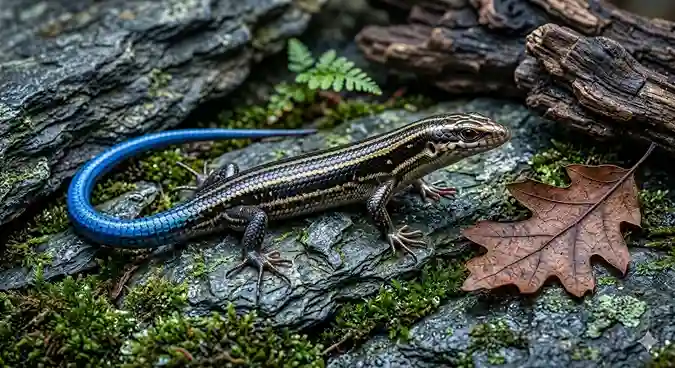
Coloration: Highly diverse. Brown, black, gray, and olive tones dominate ground-dwelling species. Some tropical skinks display brilliant blue, red, or orange markings. Juvenile five-lined skinks carry a vivid blue tail that fades with age.
Skink vs Snake vs Salamander: Key Differences
Confusing a skink with a snake happens constantly. Adding salamanders to the mix creates more confusion. Here is how to tell them apart:
| Feature | Skink | Snake | Salamander |
| Eyelids | Present, movable | Absent, fixed spectacle | Present, movable |
| Ear openings | Visible | Absent | Absent |
| Legs | Usually present (reduced in some) | Absent | Present (4 limbs) |
| Scales | Smooth, overlapping | Variable, dry | No scales (moist skin) |
| Tail autotomy | Yes | No | Yes (some species) |
| Habitat | Dry to semi-moist | Dry | Moist, near water |
| Skin texture | Dry, glossy | Dry | Slimy, permeable |
The easiest field mark: skinks have visible ear holes and movable eyelids. Snakes lack both. Salamanders lack scales entirely and need moisture to survive.
Where Do Skinks Live? Global Distribution and Preferred Habitats
Skinks occupy every continent except Antarctica. Their adaptability explains this wide range. From rainforest floors to desert dunes, skinks find ways to thrive.
Preferred habitats include:
- Leaf litter in deciduous forests
- Rocky outcrops and stone walls
- Desert sand and gravel plains
- Grasslands and savannas
- Suburban gardens and parks
- Coastal dunes and mangroves
Regional distribution highlights:
- Australia hosts over 400 species, making it the global skink capital
- Africa contains diverse genera adapted to arid conditions
- Southeast Asian rainforests shelter arboreal and semi-aquatic species
- North America has approximately 15 native species, mostly in the genus Plestiodon
- Europe has fewer species, concentrated around the Mediterranean
- South America features unique genera in tropical ecosystems
Skinks require cover. Rocks, logs, leaf piles, and loose soil provide the shelter these secretive lizards demand. Gardens with mulch, ground cover plants, and sun-exposed stones often attract local skink populations.
Skink Behavior and Daily Activity Patterns
Understanding skink behavior reveals why these lizards succeed across so many environments.
Activity patterns: Most skinks are diurnal, meaning they hunt and bask during daylight hours. A few species exhibit crepuscular behavior, preferring dawn and dusk. Nocturnal skinks are rare.
Thermoregulation: As ectotherms, skinks rely on external heat sources. You often spot them basking on rocks or pavement in the morning sun. Once warmed, they actively forage. During extreme heat, they retreat to cooler burrows.
Defense mechanisms:
- Tail autotomy as the primary escape strategy
- Burrowing rapidly into loose substrate
- Hiding under rocks and debris
- Some species bite when cornered
- A few Australian species display threat postures with open mouths
Social behavior: Most skinks are solitary. They interact primarily during breeding season. However, a few Australian species in the genus Egernia form family groups and recognize kin. The Great Desert skink even builds communal burrow systems used by multiple generations.
Hunting strategy: Skinks are active foragers. They move through leaf litter, using their forked tongues to sample chemical cues. When prey appears, they dash forward and seize it with strong jaws.
What Do Skinks Eat? Diet and Feeding Habits
The skink diet reflects their opportunistic nature. Most species eat a varied menu of invertebrates, though some supplement with plant matter.
Common prey items:
- Crickets and grasshoppers
- Beetles and their larvae
- Spiders of various sizes
- Earthworms and slugs
- Moths and caterpillars
- Small snails
- Ants and termites
Omnivorous species: Blue-tongued skinks (Tiliqua genus) eat both animal protein and vegetation. Their diet includes insects, snails, berries, flowers, and fungi. In captivity, they readily accept dog food, eggs, and mixed vegetables.
Hunting techniques: Skinks rely on visual and chemical cues. Their forked tongues collect scent particles, which they process through the Jacobson’s organ in the roof of their mouth. Quick bursts of speed capture prey before it escapes.
Water needs: Most skinks obtain moisture from their food. Dew drops on vegetation provide additional hydration. Desert species have evolved efficient kidneys that conserve water.
Skink Reproduction and Life Cycle
Skinks display two primary reproductive strategies. Most species lay eggs, but some give birth to live young.
Egg-laying (Oviparous) species:
- Females deposit clutches of 2-20 eggs
- Eggs are leathery, not hard-shelled
- Nesting sites include rotting logs, soil cavities, and leaf litter
- Some species guard their eggs until hatching
- Incubation typically lasts 4-8 weeks depending on temperature
Live-bearing (Viviparous) species:
- Embryos develop inside the mother’s body
- Nutrition transfers through a primitive placenta
- Birth occurs in sheltered locations
- Common in cooler climates where eggs would struggle to develop
- The common lizard (Zootoca vivipara) demonstrates this adaptation
Parental care: Skink parental care ranges from none to extensive. Most egg-laying species abandon their clutches immediately. A few species, like the five-lined skink, coil around their eggs and defend them against predators. Some Egernia species guard their young for weeks after birth.
Growth and maturity: Juvenile skinks grow rapidly during their first year. Sexual maturity arrives between 1-3 years depending on species. Lifespans range from 3-5 years for small species to over 20 years for larger ones. Blue-tongued skinks in captivity regularly exceed 15 years.
Common Skink Species and Their Unique Traits
The sheer variety within the Scincidae family deserves attention. Here are notable species that showcase the breadth of skink meaning and diversity:
Five-Lined Skink (Plestiodon fasciatus): Native to eastern North America. Juveniles sport a brilliant blue tail and five cream-colored stripes. They prefer wooded areas with abundant ground cover. Males develop orange-red facial coloration during breeding season.
Blue-Tongued Skink (Tiliqua scincoides): An Australian icon with a distinctive blue tongue used to startle predators. These heavy-bodied skinks reach 18-24 inches. Popular in the pet trade for their calm demeanor.They consume both animal and plant stuff.
West African woods are home to the fire skink (Lepidothyris fernandi). Their backs display brilliant red, gold, and black patterns. These medium-sized skinks require humid terrariums in captivity. Secretive by nature, they spend much time buried in substrate.
Western Skink (Plestiodon skiltonianus): Another North American species with a bright blue tail in juveniles. Found across the western United States and into Canada. They prefer open woodlands and rocky hillsides.
Solomon Islands Skink (Corucia zebrata): The largest living skink, reaching nearly 2.5 feet. This arboreal species lives in social groups—rare among reptiles. It gives birth to a single large offspring after a 6-8 month gestation. Herbivorous, feeding on leaves and fruits.
Sandfish Skink (Scincus scincus): A desert specialist that literally swims through loose sand. Its smooth scales and wedge-shaped head reduce friction. Found across North Africa and the Middle East. Rarely surfaces except to bask or hunt.
Crocodile Skink (Tribolonotus gracilis): Native to New Guinea. Four rows of raised, spiky scales run down its back, resembling crocodile armor. Small, reaching only 8-10 inches. When startled, it freezes and may vocalize—a rare trait among lizards.
Keeping Skinks as Pets: What You Must Know
Several skink species thrive in captivity when properly cared for. Blue-tongued skinks lead the pack in popularity, followed by fire skinks and Schneider’s skinks.
Essential care requirements:
- Enclosure size: Minimum 40-gallon tank for blue-tongued skinks; 20-gallon long for smaller species
- Substrate: Coconut coir, cypress mulch, or bioactive soil mixes that retain humidity and allow burrowing
- Temperature gradient: Basking spot at 95-105°F (35-40°C); cool side at 75-80°F (24-27°C)
- UVB lighting: Essential for calcium metabolism; replace bulbs every 6-12 months
- Humidity: 40-60% for arid species; 70-80% for tropical species like fire skinks
- Diet variety: Gut-loaded insects, appropriate vegetables, and calcium supplements
- Water: Clean, shallow water dish changed daily
- Hides: Multiple hiding spots on both warm and cool sides
Species recommended for beginners:
- Northern blue-tongued skink (hardy, docile, readily available captive-bred)
- Schneider’s skink (smaller, active, relatively easy care)
- Peter’s banded skink (small, handleable, captive-bred available)
Common mistakes new owners make:
- Using sand substrate for species that need humidity
- Providing inadequate UVB or skipping it entirely
- Feeding only one type of insect without variety
- Handling too frequently during the adjustment period
- Neglecting to research the specific skink meaning in terms of species-specific needs
Skink Conservation Status and Environmental Threats
Many skink species face mounting pressure from human activity. The IUCN Red List tracks numerous threatened and endangered species.
Primary threats to skink populations:
- Habitat destruction from agriculture, urbanization, and logging
- Invasive predators including cats, rats, and fire ants
- Climate change altering temperature and moisture patterns
- Collection for the pet trade (particularly wild-caught specimens)
- Pesticide use reducing insect prey availability
Critically endangered skinks:
- Christmas Island blue-tailed skink—extinct in the wild, surviving only in captive breeding programs
- Bermuda skink—restricted to small offshore islets
- Several Caribbean island endemics threatened by development
Conservation efforts underway:
- Captive breeding programs for critically endangered species
- Habitat restoration projects in key regions
- Invasive predator control on islands
- Legal protections under CITES for certain species
- Public education about local skink populations
Gardeners and homeowners can help local skinks by avoiding pesticides, maintaining leaf litter patches, and keeping cats indoors. Small actions create habitat refuges for these beneficial insect-eaters.
Skink Symbolism and Cultural Significance
Beyond biology, the skink meaning carries symbolic weight across different cultures.
Spiritual and symbolic interpretations:
- Adaptability—skinks thrive in diverse environments
- Regeneration—tail regrowth represents healing and renewal
- Grounding—their earth-bound nature connects to stability
- Quick thinking—rapid movements symbolize mental agility
- Invisibility—their secretive habits represent knowing when to stay hidden
Cultural references:
- Aboriginal Australian stories feature skinks as clever survivors
- Some Pacific Island cultures view skinks as messengers between worlds
- In modern dream interpretation, skinks represent hidden fears or overlooked opportunities
- Feng shui practitioners associate lizards, including skinks, with good fortune
Scottish “skink” connection: The unrelated culinary term “skink” survives in Cullen skink, a creamy smoked haddock chowder. This linguistic parallel creates occasional confusion but enriches the word’s history.
How to Identify Skinks in Your Backyard or on Hikes
Spotting a skink takes patience. These tips improve your chances and help with accurate identification.
Where to look:
- Flip logs and rocks carefully (and replace them afterward)
- Check sunny patches near ground cover in the morning
- Examine leaf litter edges
- Look along fence lines and stone walls
- Scan garden mulch and compost areas
Identification checklist:
- Does the body appear smooth and shiny?
- Are the scales small and overlapping?
- Can you see ear openings on the side of the head?
- Do the legs appear small relative to the body?
- Is the tail long and tapering?
- Does it move with a snake-like slither when startled?
Photography tips:
- Move slowly to avoid spooking the skink
- Use a zoom lens to maintain distance
- Photograph from ground level for the best angle
- Capture multiple angles for identification purposes
- Note the habitat and location for later research
Recording sightings: Apps like iNaturalist allow you to log skink observations. These citizen science contributions help researchers track population trends and distribution changes.
Frequently Asked Questions About Skink Meaning
What exactly is a skink?
A skink is a member of the Scincidae family of lizards.Skinks have smooth, overlapping scales, elongated bodies, and typically reduced limbs. With more than 1,500 species found throughout most of the planet, they are the most diverse family of lizards.
How is a skink different from a regular lizard?
The skink meaning differentiates them by body shape. Regular lizards typically have raised bodies, long legs, and rough scales. Skinks have cylindrical, snake-like bodies, shorter legs, and glossy scales. They also move differently, slithering more than walking.
Are skinks dangerous or venomous?
No skink species poses any danger to humans. They have small teeth suited for gripping insects. A bite from a large skink may pinch but rarely breaks skin. Skinks carry no venom. Their primary defense involves fleeing or dropping their tail.
What does finding a skink in my house mean?
A skink inside your home likely entered accidentally while hunting insects. It does not indicate an infestation or spiritual message. Gently capture it using a container and release it outside near ground cover. Seal gaps under doors to prevent future visits.
Can skinks regrow their tails?
Yes, skinks can voluntarily shed their tails when threatened—a process called autotomy. The detached tail continues wriggling to distract predators. A new tail grows back over weeks to months, though it typically appears shorter and darker than the original.
What do skinks eat in the wild and as pets?
Wild skinks eat primarily insects and other invertebrates. Common prey includes crickets, beetles, spiders, earthworms, and caterpillars. Some larger species eat small vertebrates, fruits, and flowers. Pet skinks need a varied diet of gut-loaded insects supplemented with vegetables and calcium powder.
How Understanding Skink Meaning Deepens Your Connection to Nature
Skinks live quietly among us. Garden walls, forest floors, desert sands—these lizards have carved out niches everywhere warmth and cover exist. Learning the skink meaning shifts something in how you see the outdoors. That flash of movement in the leaf litter becomes recognizable. You stop wondering “snake or lizard” and start noticing the delicate ear opening, the smooth scales, the tiny legs pushing through mulch.
These creatures have survived for millions of years. They’ve adapted to rainforests and deserts, to suburbia and wilderness. When you understand what a skink is—truly understand—you join a lineage of observers who looked closely at the natural world and found something remarkable hiding in plain sight.
Walk outside tomorrow morning. Find a sunny rock near some ground cover. Stand still for a moment. There’s a good chance a skink is watching you right back.
Author Note: This guide draws on published herpetological research, field observations, and direct experience keeping and observing skink species. Sources include peer-reviewed studies from Journal of Herpetology, IUCN Red List assessments, and taxonomic references from the Reptile Database.