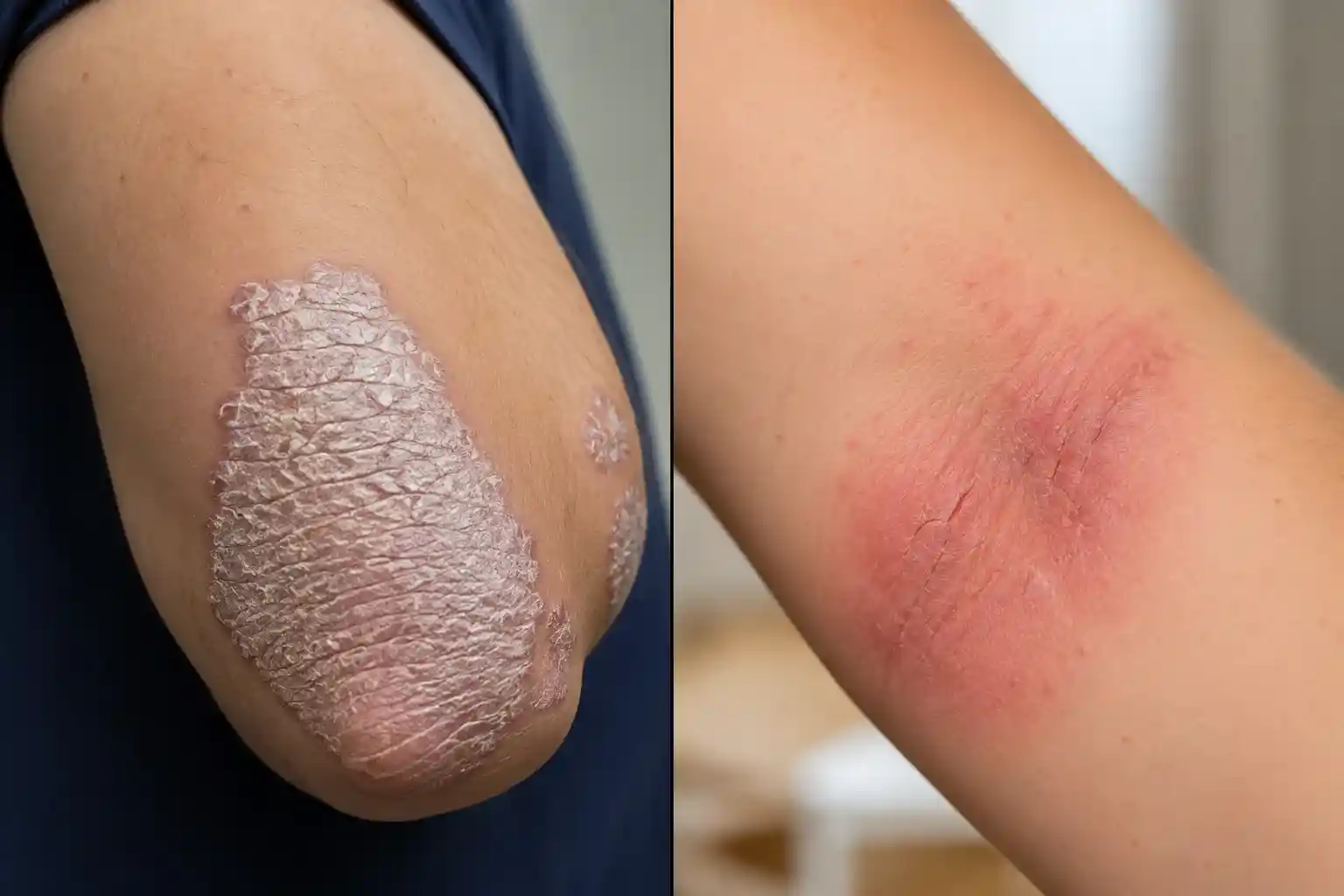
Psoriasis vs Eczema
Your skin is red, scaly, and won’t stop itching — but is it psoriasis or eczema? You’re not alone in wondering. Even dermatologists sometimes need a closer look, a dermatoscope, or a skin biopsy to be certain, because the two conditions can overlap in appearance. This guide breaks down the difference between psoriasis and eczema using the visual clues, body locations, and symptom patterns that doctors actually rely on, so you can walk into your next appointment with the right questions instead of more confusion.
Medical disclaimer: This material should not be used in place of expert medical advice; it is merely meant to be informative. For a precise diagnosis, always seek the advice of a board-certified dermatologist.
Key Takeaways
- Psoriasis is an autoimmune disease that causes thick, red, scaly patches (plaques) with sharply defined edges. Eczema is a chronic inflammatory skin condition that causes dry, intensely itchy, red rashes with blurry, ill-defined borders.
- The clearest visual tell: psoriasis plaques look like silvery, “stuck-on” scale, while eczema patches often look raw, weeping, or leathery from repeated scratching.
- Psoriasis tends to favor the scalp, elbows, knees, and lower back. Eczema favors the creases of the elbows and knees, the hands, and the neck.
- Neither condition is contagious, and both can respond to topical steroids — but moderate-to-severe cases of either disease increasingly call for targeted biologics or oral systemic medications, not just creams.
What Is Psoriasis? A Quick Overview
Psoriasis is a chronic autoimmune skin disease that speeds up the life cycle of skin cells, causing them to build up rapidly on the surface and form thick, silvery scales over dry, itchy, sometimes painful red patches.
The most common form, plaque psoriasis, accounts for roughly 80–90% of cases. Globally, psoriasis affects an estimated 2–3% of the population, according to the National Psoriasis Foundation and the World Health Organization. It has a strong genetic component — if one parent has psoriasis, a child’s risk rises meaningfully, and that risk climbs further if both parents are affected. Common triggers include emotional stress, strep throat and other infections, skin injury, certain medications (lithium, beta-blockers, antimalarials), heavy alcohol use, and smoking.
Psoriasis is not just a “skin problem.” It’s classified as a systemic, T-cell-mediated autoimmune condition, which is why roughly 30% of people with psoriasis eventually develop psoriatic arthritis, a related joint condition.
What Is Eczema (Atopic Dermatitis)? A Quick Overview
Eczema — often used interchangeably with atopic dermatitis, its most common form — is a chronic inflammatory skin condition characterized by dry, itchy, red, and cracked skin. It results from a combination of genetic, immune, and environmental factors that weaken the skin’s natural barrier, allowing moisture to escape and irritants to get in.
Eczema is extremely common, affecting up to 20% of children worldwide and roughly 7–10% of adults, per data cited by the National Eczema Association. It often appears in infancy and is frequently part of what’s called the “atopic triad,” alongside asthma and seasonal allergies. Flares are commonly triggered by harsh soaps, fragrances, dry winter air, dust mites, sweat, emotional stress, and, in some people, specific foods such as dairy, eggs, or nuts.
Unlike psoriasis, eczema centers on a barrier problem as much as an immune one — the skin simply can’t hold onto water the way healthy skin does, which is why intense dryness is almost always part of the picture.
Psoriasis vs Eczema: 7 Key Differences That Help You Tell Them Apart
When you’re comparing psoriasis or eczema, these seven factors are what dermatologists check first.
| Feature | Psoriasis | Eczema (Atopic Dermatitis) |
|---|---|---|
| Cause | Autoimmune, T-cell mediated | Impaired skin barrier + immune dysregulation |
| Appearance | Thick, red plaques with silvery-white scale | Dry, red, scaly patches; often weeping or crusted |
| Borders | Well-defined, sharply demarcated | Ill-defined, diffuse |
| Itch | Variable — mild to severe | Intensely itchy, often worse at night |
| Common locations | Scalp, elbows, knees, lower back, nails | Inner elbows, behind the knees, hands, face, neck |
| Age of onset | Peaks at 20–30 and again at 50–60 years | Often begins in infancy; can persist into adulthood |
| Koebner phenomenon | Yes — new lesions can form at sites of skin injury | No |
Cause: Psoriasis is driven by an overactive immune response in which T-cells mistakenly attack healthy skin cells, accelerating skin-cell turnover from roughly a month down to just a few days. Eczema, by contrast, starts with skin-barrier dysfunction — often linked to a mutation in the filaggrin gene — that lets the immune system overreact to everyday irritants and allergens.
Appearance: Psoriasis plaques have a hallmark “stuck-on” silvery scale sitting atop salmon-pink skin. Eczema rashes look more variable: dry and scaly in some people, oozing or crusted in others, especially after scratching breaks the skin.
Borders: This is one of the fastest visual differentiators. Run a finger along the edge of a psoriasis plaque, and you can usually trace a clean line where affected skin meets normal skin. Eczema patches fade gradually into surrounding skin with no clear edge.
Itch: Eczema is famous for its itch — patients often describe it as unbearable, especially at night. Psoriasis itch is more unpredictable; some patients report little to no itching, while others find it as intense as eczema.
Common locations: Psoriasis gravitates toward extensor surfaces (the outside of elbows and knees), the scalp, and the lower back. Eczema prefers flexor surfaces (the inner creases of elbows and knees), plus the hands, face, and neck — though in infants it commonly appears on the cheeks and scalp.
Age of onset: Eczema usually shows up first, often within the first six months of life, and may improve or resolve by adulthood. Psoriasis tends to appear later, with two typical onset peaks in early adulthood and again in late midlife.
Koebner phenomenon: Psoriasis has a distinctive quirk — new plaques can form at the site of a cut, scratch, sunburn, or even a tattoo. This is called the Koebner phenomenon, and eczema does not share it.
Visual Clues: How to Recognize Psoriasis vs Eczema on the Body
Picture the outer elbow with a thick patch that looks like someone dabbed on silvery-white paint and let it dry — that’s a classic psoriasis plaque, well-demarcated, salmon-pink, and slightly raised. Scratch the surface and you’ll often see fine, flaking scale come away first.
Now picture the inner crook of the same arm: skin that’s red, raw, and feels like fine sandpaper, with no clear edge where the rash stops. That’s textbook eczema. After repeated scratching, the skin can thicken and develop deep, leathery folds — a process called lichenification.
These descriptions are useful for narrowing things down, but they are not a substitute for an in-person exam. Several other conditions, including seborrheic dermatitis, ringworm, and contact dermatitis, can mimic both diseases.
Itch, Pain, and Quality of Life: The Patient Experience
Numbers on a chart don’t capture what living with either condition feels like day to day.
With eczema, the itch is often the defining symptom — patients frequently describe a vicious scratch-itch cycle: the itch drives scratching, scratching damages the skin barrier further, and that damage produces more itch. This cycle commonly disrupts sleep and raises the risk of secondary skin infections when bacteria enter through broken skin.
Psoriasis is frequently less about itch and more about the physical toll of thick, inflexible plaques. Skin over joints like the elbows and knees can crack and bleed with normal movement. For the roughly 30% of patients who develop psoriatic arthritis, joint pain and stiffness add another layer of daily difficulty that goes well beyond the skin itself. Both conditions are also strongly linked to anxiety, depression, and social withdrawal, since visible skin changes can affect confidence and relationships.
Triggers and Causes: Why Me?
Psoriasis triggers commonly include:
- Emotional or physical stress
- Strep throat and other infections
- Cuts, sunburns, and vaccines that cause skin damage through the Koebner phenomenon
- Heavy alcohol consumption and smoking
- Certain medications, including lithium, beta-blockers, and antimalarials
Eczema triggers commonly include:
- Harsh soaps, detergents, and fragrances
- Dry air, especially in winter
- Dust mites and pet dander
- Sweat and overheating
- Emotional stress
- Certain foods in some individuals, particularly children (dairy, eggs, nuts)
Both conditions run in families, but the genetics differ. Psoriasis is linked to immune-regulating genes such as HLA-Cw6, while eczema is more closely tied to genes controlling the skin barrier, especially filaggrin.
Diagnosis: How Doctors Distinguish Psoriasis from Eczema
Most dermatologists can diagnose either condition through a visual exam and a review of personal and family history. When the picture is unclear, dermatoscopy — a magnified, lit examination of the skin — can reveal pattern differences invisible to the naked eye.
In ambiguous cases, a skin biopsy settles the question at the cellular level. Psoriasis biopsies typically show Munro’s microabscesses (clusters of immune cells within the outer skin layer) and a thickened epidermis. Eczema biopsies typically show spongiosis, a pattern of fluid buildup between skin cells that creates a sponge-like appearance under the microscope. These pathology findings are part of why a dermatologist’s exam carries more weight than a home comparison of photos.
Treatment Approaches: Topical, Systemic, and Beyond
Treatment overlaps in places but diverges significantly for moderate-to-severe disease.
| Treatment Type | Psoriasis | Eczema |
|---|---|---|
| Topical corticosteroids | First-line for mild-to-moderate disease | First-line, used cautiously on thin skin (face, eyelids) |
| Vitamin D analogs | Calcipotriene/calcitriol, often combined with steroids | Not typically used |
| Topical PDE4 inhibitors | Roflumilast (Zoryve) cream and foam | Roflumilast (Zoryve) cream, approved down to age 2 |
| Topical AhR agonist | Tapinarof (Vtama), steroid-free option | Tapinarof (Vtama), approved for adults and children |
| Topical calcineurin inhibitors | Used off-label for face/genitals | Tacrolimus and pimecrolimus, FDA-approved |
| Topical JAK inhibitors | Not a primary option | Ruxolitinib (Opzelura); delgocitinib (Anzupgo) for chronic hand eczema |
| Phototherapy | Narrowband UVB, PUVA — highly effective | Sometimes used for widespread, treatment-resistant disease |
| Systemic oral medications | Methotrexate, cyclosporine, apremilast, deucravacitinib | Cyclosporine, methotrexate for severe, refractory cases |
| Biologics / oral systemics | TNF, IL-17, and IL-23 inhibitors; icotrokinra (an oral IL-23 receptor blocker) | Dupilumab (Dupixent) and lebrikizumab (Ebglyss) target IL-4/IL-13; oral JAK inhibitors abrocitinib and upadacitinib |
Treatment in this space is moving quickly. In the past two years, regulators have approved several non-steroidal options — including tapinarof and roflumilast — for use in both conditions, expanding choices for patients who can’t tolerate long-term steroid use. On the systemic side, dupilumab and lebrikizumab have reshaped moderate-to-severe eczema care, while newer IL-23-targeted therapies, including an oral option, are doing the same for psoriasis. Because this area changes so quickly, ask your dermatologist which option is newest and best suited to your case rather than relying on any single article.
When to See a Doctor
See a dermatologist if a rash doesn’t improve with over-the-counter moisturizers or hydrocortisone within two to three weeks, if it’s spreading, painful, oozing pus, or accompanied by fever, or if the itching is disrupting sleep or daily function. Joint pain or stiffness alongside a scaly rash warrants a prompt visit, since early treatment of psoriatic arthritis can prevent permanent joint damage. A professional diagnosis matters because the wrong treatment — for example, certain steroids used incorrectly — can occasionally worsen the other condition.
Living with Psoriasis or Eczema: Lifestyle and Home Care
Day-to-day management overlaps more than the underlying biology does:
- Moisturize consistently. Thick, fragrance-free emollients applied right after bathing help both conditions by supporting the skin barrier.
- Manage stress. Both diseases flare with stress, so techniques like regular exercise, mindfulness, or therapy can reduce flare frequency.
- Use a humidifier in dry months to reduce moisture loss from the skin.
- Identify your personal triggers. Keep a simple log of flares alongside diet, weather, and stress levels to spot patterns.
- Be cautious with elimination diets. Some eczema patients benefit from removing specific food triggers, but this should be done under medical or dietitian supervision to avoid unnecessary nutritional restriction, especially in children.
- Consider an anti-inflammatory diet for psoriasis — some patients report fewer flares with reduced processed sugar and alcohol, though evidence varies by individual.
- Protect your skin barrier. Lukewarm (not hot) showers and gentle, fragrance-free cleansers benefit both conditions.
A Short Glossary
- Plaque: A raised, thickened patch of skin — the hallmark lesion of psoriasis.
- Lichenification: Thickened, leathery skin caused by chronic scratching, common in long-standing eczema.
- Koebner phenomenon: New psoriasis lesions appearing at a site of skin trauma.
- Spongiosis: Microscopic fluid buildup between skin cells, seen in eczema biopsies.
- Biologic: An injectable or infused medication derived from living cells that targets a specific part of the immune system.
- JAK inhibitor: A drug that blocks Janus kinase enzymes involved in inflammatory signaling; available in both topical and oral forms.
Conclusion
Psoriasis and eczema can look and feel similar at a glance, but the underlying biology — and the visual signals dermatologists look for — are genuinely distinct. Psoriasis is an autoimmune condition marked by well-defined, silvery plaques; eczema is a barrier-and-immune condition marked by ill-defined, intensely itchy patches. If you’re still unsure which one you’re dealing with, that uncertainty is common, even among experienced clinicians at first glance — which is exactly why a board-certified dermatologist’s exam, and sometimes a biopsy, is the most reliable way to get a definitive answer and the right treatment plan.
Frequently Asked Questions
Is it possible to have eczema and psoriasis simultaneously?
Yes. Although rare, it is medically conceivable to have both illnesses at the same time since they affect distinct immunological pathways that intersect. Dermatologists diagnose this through careful exam and sometimes biopsy of separate lesions, then build a treatment plan that addresses both conditions without worsening either one.
Is psoriasis or eczema more common?
Eczema is more common overall, affecting up to 20% of children and roughly 7–10% of adults worldwide. Psoriasis affects a smaller share of the population, around 2–3% globally, though it tends to be a lifelong condition once it appears in adulthood.
Does psoriasis itch like eczema?
Sometimes, but less predictably. Eczema is almost always intensely itchy, especially at night. Psoriasis itch varies widely between patients — some experience minimal itching, while others find their plaques just as itchy and uncomfortable as eczema.
Is it possible for psoriasis to develop into eczema or vice versa?
No, one condition does not become the other. They have distinct underlying causes — psoriasis is autoimmune, eczema is barrier-and-immune driven — though a person can be diagnosed with both conditions independently over a lifetime.
Is psoriasis contagious like eczema?
Neither condition is contagious. You cannot catch psoriasis or eczema from touching someone else’s skin, sharing towels, or close contact. Both are driven by internal immune and genetic factors, not by infectious organisms.
How do I know if my rash is psoriasis or eczema?
Look at the border and texture: psoriasis plaques have sharp edges and silvery scale, while eczema patches are blurry-edged and often weeping or leathery. Location matters too — psoriasis favors elbows, knees, and scalp; eczema favors skin creases. A dermatologist can confirm with an exam.
Next up: read our guide on natural remedies for eczema flares.
Sources: American Academy of Dermatology (AAD), National Psoriasis Foundation, National Eczema Association, World Health Organization, and peer-reviewed dermatology literature including the Journal of the American Academy of Dermatology. This article should be reviewed periodically by a board-certified dermatologist and updated as new treatments receive FDA approval.