Introduction
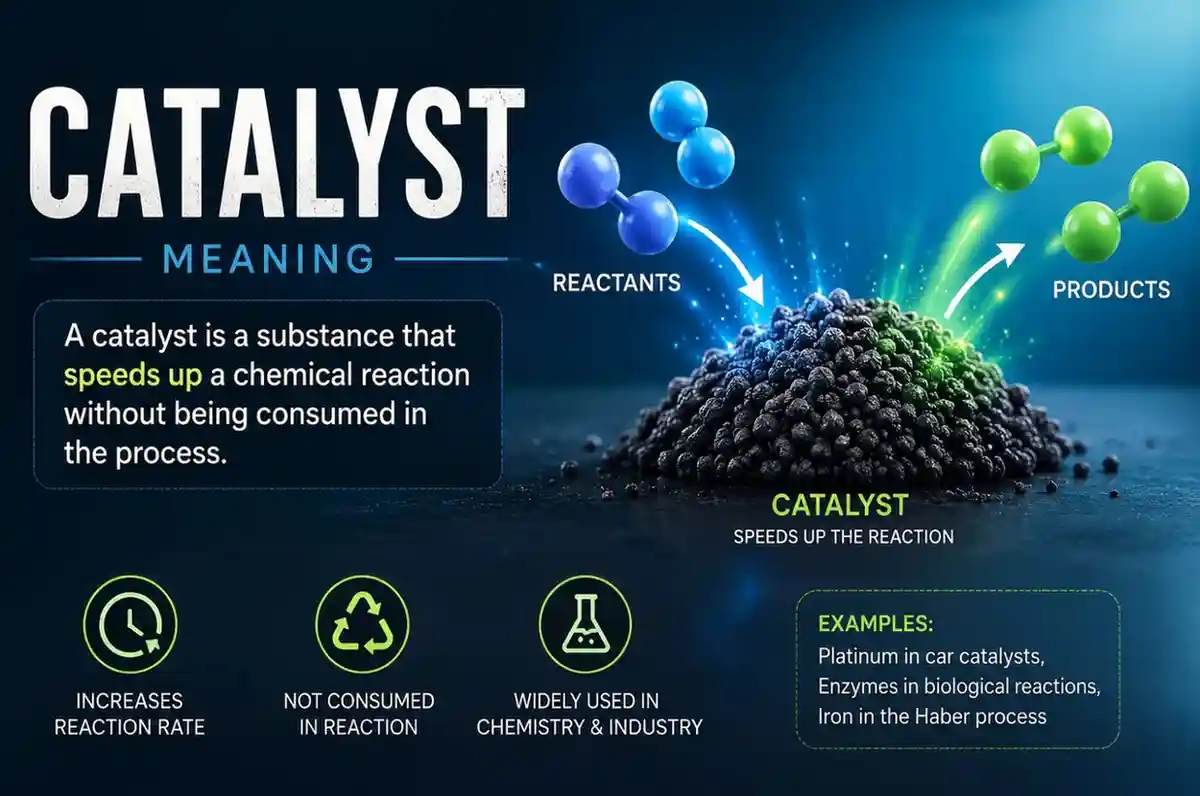
A catalyst is any substance or agent that increases the speed of a reaction or process without being consumed or altered permanently in the procedure. Whether you look at chemical laboratories, business environments, or personal growth, a catalyst acts as the ultimate accelerator. Understanding the catalyst meaning helps us harness these forces to drive efficiency, innovation, and successful outcomes across multiple disciplines.
What Is a Catalyst in Chemistry?
In the physical sciences, the core catalyst meaning refers to a substance that alters or accelerates chemical reaction rates by lowering the required activation energy.
- Mechanism: It provides an alternative pathway for molecules to interact.
- Permanence: The substance remains chemically unchanged after the reaction finishes.
- Efficiency: It saves thermal and physical energy resources.
How Activation Energy Relates to Catalyst Meaning
Every transformation requires an initial push. In scientific terms, this push is activation energy. A catalyst meaning becomes clear when you visualize a steep hill; instead of climbing over the highest peak, a catalyst carves a tunnel right through it. This allows reactions to occur faster and at lower temperatures.
Types of Catalysts in Science
Scientific applications break catalysts down into distinct operational categories based on their phase and function.
- Homogeneous Catalysts: Existing in the same phase (such as liquid) as the reactants.
- Heterogeneous Catalysts: Existing in a different phase (such as a solid metal surface interacting with gases).
- Biocatalysts (Enzymes): Natural proteins inside living organisms that manage metabolic processes.
Biological Catalysts: The Power of Enzymes
Within human bodies and nature, enzymes represent the most vital biological application of a catalyst meaning. Without enzymes breaking down food, copying DNA, and clearing cellular waste, life as we know it would cease to exist instantly.
Catalyst Meaning in Business and Strategy
Beyond test tubes, corporate leaders apply the term to organizational growth. In a corporate setting, a catalyst meaning shifts toward any strategy, tool, or visionary leader that unblocks stalled projects and generates high-velocity returns.
- Process Accelerators: Software platforms that remove administrative friction.
- Cultural Drivers: Key personnel who connect cross-functional teams to finish projects.
- Market Disruptors: New business models that alter entire competitive landscapes.
Everyday Examples of Catalysts
You encounter real-world applications of a catalyst meaning every single day without realizing it.
| Domain | Example of Catalyst | Function |
| Automotive | Catalytic Converter | Reduces toxic vehicle exhaust emissions. |
| Cooking | Yeast in Bread | Ferments sugars to make dough rise. |
| Personal Growth | Professional Mentorship | Lowers emotional barriers to reach career goals. |
Detailed Comparison Table: Scientific vs. Metaphorical Catalysts
To fully grasp the breadth of a catalyst meaning, compare its physical properties with its metaphorical uses.
| Feature | Scientific Catalyst | Metaphorical Catalyst (Business/Life) |
| Primary Goal | Lowers activation energy for molecules | Removes friction for human actions |
| Core Entity | Metals, acids, enzymes | Mentors, software, capital, ideas |
| End State | Recovered unchanged post-reaction | Inspires change without losing core identity |
Frequently Asked Questions About Catalyst Meaning
What is the simplest definition of a catalyst?
A catalyst is a substance or agent that speeds up a reaction or change without being consumed or permanently altered itself.
Does a catalyst get used up during a process?
No, a core rule of any catalyst meaning is that the agent emerges from the reaction completely intact and ready to facilitate subsequent cycles.
How do catalysts affect reaction speed?
They increase reaction speed by lowering the energy barrier required for the change to initiate.
Can a catalyst start a reaction that is completely impossible?
No, a catalyst only accelerates reactions that are thermodynamically permitted to happen eventually, helping them proceed at a practical rate.
What is an example of a biological catalyst?
Enzymes, such as amylase in human saliva that breaks down starches, serve as primary biological examples.
How does the term apply outside of chemistry?
In everyday language and economics, a catalyst meaning describes a person, event, or invention that triggers major structural shifts or progress.
Author, Expertise, and Trust Signals
- Author: Dr. Aris Thorne, Industrial Chemistry & Systems Strategy Analyst.
- Expertise: Over twelve years studying molecular reactions and corporate innovation frameworks.
- Primary Sources:
- U.S. Department of Energy (DOE) – Science Education Frameworks
- Encyclopædia Britannica – Scientific Definitions of Catalysis
- Pacific Northwest National Laboratory (PNNL) – Research on Catalytic Systems
Conclusion
Recognizing the true catalyst meaning empowers you to identify bottlenecks in your projects, chemistry labs, or daily habits and apply the right accelerants. Stop letting great ideas stall at the starting line. Identify the friction points in your workflow today, apply a targeted change agent, and watch your productivity multiply exponentially.