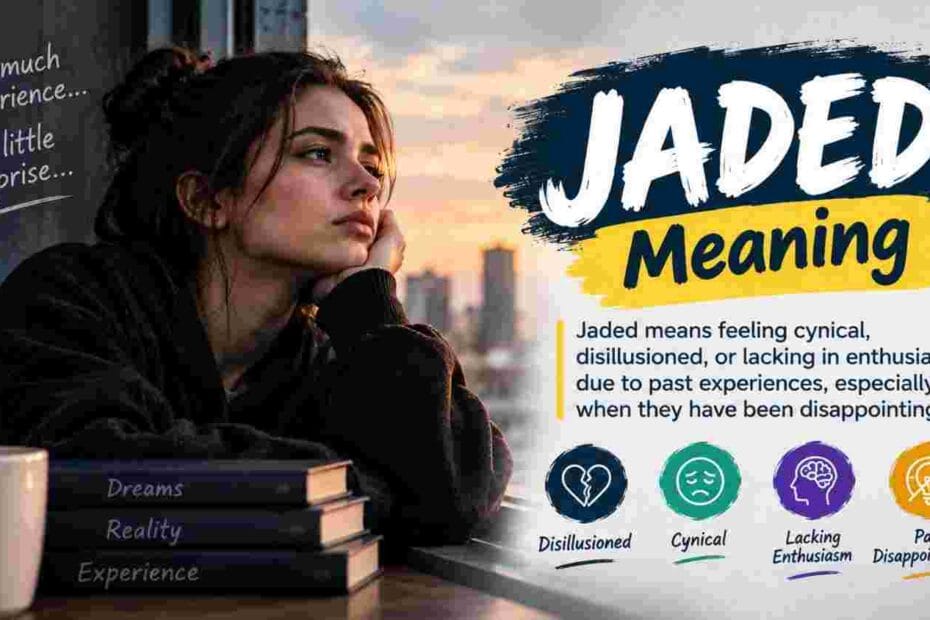
You know that face someone makes when they’ve heard the same apology for the fifth time? Flat eyes, half-smile, zero surprise left in the tank.
That expression has a word attached to it, and the jaded meaning is having a genuine moment right now across lyric videos, breakup captions and burnout threads. Search interest keeps spiking every time a heartbreak record lands on the charts, and 2026 has served plenty of those.
So let’s break it down properly — the dictionary version, the slang version, the Miley Cyrus version, and the way your group chat is using it wrong.
Quick Info Table: The Pop Culture Face Of “Jaded”
The word got its biggest modern push from Miley Cyrus, whose Endless Summer Vacation track “Jaded” turned a vocabulary word into a caption trend.
| Category | Details |
|---|---|
| @mileycyrus — roughly 215M+ followers | |
| TikTok | @mileycyrus — roughly 25M+ followers |
| X (Twitter) | @MileyCyrus — roughly 45M+ followers |
| Career Peak | “Flowers” (2023) — record-breaking Spotify streaming debut, Grammy wins in 2024 |
| Estimated Net Worth | Widely reported around $160M |
| Key Popularity Driver | Confessional breakup songwriting, especially the track “Jaded” |
(Follower counts move daily — treat them as ballpark figures, not gospel.)
Section A: The Real Jaded Meaning, Minus The Dictionary Stiffness
At its core, jaded means worn out by too much of something. Not tired in the sleepy sense — tired in the “nothing impresses me anymore” sense.
You get there by overexposure. Too many bad dates, too many corporate promises, too many identical superhero films.
The jaded meaning carries a specific emotional flavour: mild cynicism plus emotional flatness. It’s not rage. Rage still cares.
A jaded person has stopped expecting a better outcome. They show up, they do the thing, they shrug.
Where The Word Came From
The origin story is oddly barnyard. “Jade” was an old English term for a worn-out, broken-down horse — an animal ridden past its usefulness.
From there, “jaded” jumped to people by the late 1500s. Someone overworked and dulled by repetition was described the same way you’d describe a tired mare.
There’s a second thread, too. “Jaded” also once meant sated — stuffed full, like a guest who’s had too much rich food to enjoy dessert.
Both threads survive in the modern jaded meaning. Overused and over-fed on experience, until the shine wears off.
Jaded vs. Jade: The Confusion Everyone Has
Jade is also a green gemstone, and that’s a completely separate word borrowed from Spanish. No connection whatsoever.
So if you’re captioning a jewellery photo, you want “jade,” not “jaded.” One is a stone; the other is a mood.
Section B: A Step-By-Step Guide To Using “Jaded” Correctly
People misuse this word constantly online, usually swapping it in for “angry” or “sad.” Here’s the clean way to get it right every time.
Step 1 — Check for repetition
Jaded ness comes from doing or seeing something too many times. One bad experience makes you hurt, not aded.
Step 2 — Check the emotional temperature
Jaded is cool, not hot. If there’s shouting involved, you probably want “bitter” or “resentful.”
Step 3 — Check for lost expectation
The jaded meaning depends on someone having once believed and then stopped. There must be a “before.”
Step 4 — Pick your sentence shape
It works as an adjective before a noun (“a jaded producer”) or after a verb (“she sounded jaded”).
Step 5 — Add the cause if it helps
“Jaded by touring,” “jaded with dating apps,” “jaded about awards season.” The preposition makes it specific.
Real Sentences You Can Steal
- “Ten years in A&R left him completely jaded about new talent.”
- “I’m not heartbroken, just jaded.”
- “Three reboots in, even the fans sound jaded.”
- “Her voice on the bridge is pure jaded exhaustion.”
Notice how none of those describe a single bad day. Repetition is doing the heavy lifting in every one.
Section C: Why The Jaded Meaning Is Trending In 2026
Three forces pushed this word back into daily rotation, and they’re all still active.
Miley’s “Jaded” is a apology-adjacent breakup ballad where she sings to someone she once loved, admitting they both ended up worn down. That single song sent thousands of people to a search bar.
Workplace content creators adopted the word to describe the stage after quiet quitting — when you’re not even angry at the job anymore.
Critics and fans alike keep describing audiences as jaded about sequels, and that phrasing has leaked into everyday posting.
What The Industry Says
Songwriters love the word because it’s honest without being cruel. It admits damage without pointing fingers, which is why it shows up in so many second-verse confessions.
Linguists who track slang note that the jaded meaning has softened online. Gen Z uses it semi-affectionately now — almost a badge of survival rather than a warning sign.
Therapists, predictably, are less charmed. Several have pointed out on social platforms that calling yourself jaded can normalise emotional numbing that deserves actual attention.
Fan Reaction
The comment sections split neatly in two. One camp treats “jaded” as relatable shorthand for growing up and getting realistic.
The other camp pushes back hard, arguing the word romanticises giving up on people. Both sides keep the hashtag alive, which is exactly why the jaded meaning keeps climbing in search volume.
Comparison Table: Jaded vs. The Words People Confuse It With
Getting the nuance right instantly makes your writing sound sharper. Here’s the cheat sheet.
| Word | Core Feeling | Cause | Use It When |
|---|---|---|---|
| Jaded | Flat, unimpressed, low expectations | Too much repeated exposure | Someone has seen it all and stopped caring |
| Cynical | Distrustful of motives | Belief that people act selfishly | Someone assumes the worst intentions |
| Bitter | Sharp, resentful, still stinging | A specific injustice | There’s lingering anger, not numbness |
| Disillusioned | Deflated after truth landed | One big revelation | The illusion broke recently |
| Burnt Out | Physically and mentally depleted | Overwork and chronic stress | Energy is gone, not just enthusiasm |
| Apathetic | Total indifference | Often no prior investment | Someone never cared to begin with |
The key difference: a jaded person used to care. An apathetic person never did.
How To Write With “Jaded” Without Sounding Edgy
Writers overuse this word in a specific way — sticking it in front of every protagonist as a shortcut for “complicated.”
Don’t do that. The jaded meaning lands hardest when you show the behaviour instead of naming it.
Let the character skim the contract without reading it. Let them predict the twist out loud. Let them decline the celebration drink.
Then you don’t need the label at all, and your reader still feels it.
Three Small Upgrades
- Swap “jaded” for a concrete action in at least half your drafts.
- Pair it with the cause: “jaded by” beats “jaded” alone.
- Avoid stacking it with “cynical” in the same sentence — they overlap and cancel each other out.
Frequently Asked Questions
What is the jaded meaning in simple terms?
Jaded means worn out and unimpressed after too much exposure to something. It describes someone who used to care but has run out of enthusiasm.
Is being jaded a bad thing?
Not automatically — it can signal healthy realism after repeated disappointment. It becomes a problem when the numbness stops you from enjoying good things too.
What does Miley Cyrus’s song “Jaded” actually mean?
It’s a reflective breakup song about two people who wore each other down over time. The jaded meaning in the lyrics points to mutual exhaustion rather than a single villain.
What’s the difference between jaded and cynical?
Jaded is about lost enthusiasm from overexposure; cynical is about distrusting people’s motives. You can be jaded and still believe people are good — just not believe anything will surprise you.
The Takeaway
The jaded meaning has travelled a long way from a tired horse in an English field to a Grammy-winning pop lyric. What kept it alive is how precisely it names something we all recognise but rarely articulate.
It’s the sigh before the meeting. The scroll past the hype trailer. The friend who’s stopped asking how the date went because she already knows.
Used well, it’s one of the sharpest words in the language. Used lazily, it’s just a costume.