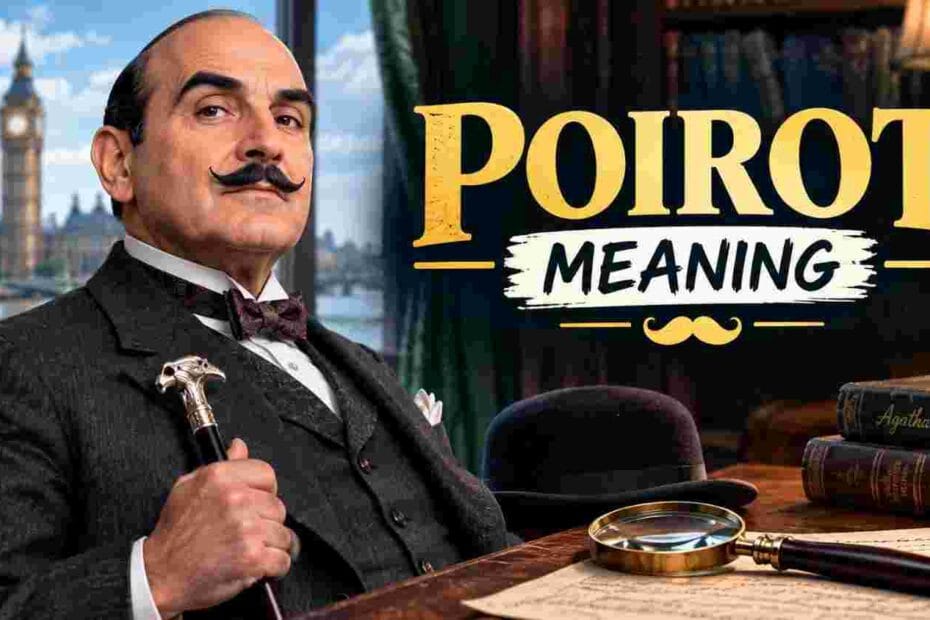
You’ve heard the name a thousand times, but almost nobody knows what “Poirot” actually means. Even hardcore Agatha Christie fans get this wrong.
Here’s the good news. By the end of this article, you’ll know the true poirot meaning, where the name came from, how to pronounce it like a native French speaker, and why this odd little surname became one of the most recognizable brands in detective fiction.
The Literal Poirot Meaning: A Name Rooted in French
Let’s cut straight to the answer. “Poirot” is a French surname derived from the word “poire,” which means “pear” in English. The suffix “-ot” is a diminutive, so the name loosely translates to “little pear.”
Yes, you read that right. The world’s most brilliant fictional detective is essentially named “Little Pear.” And that’s not an accident — Agatha Christie had a sharp sense of visual comedy.
Think about Hercule Poirot’s physical description in the books. He’s a short, round man with an egg-shaped head. A pear-shaped name for a pear-shaped man. Christie was playing a quiet joke that most English readers never caught.
Why the “Pear” Connection Makes Perfect Sense
Christie built irony directly into the name. Look at the contrast she created:
- Hercule — the French form of Hercules, the giant Greek hero of legendary strength.
- Poirot — a soft, comical word suggesting a small, plump fruit.
A tiny, fussy Belgian man carrying the name of a muscular demigod, paired with a surname meaning “little pear”? That’s deliberate comedy. Christie wanted readers to underestimate him, just like the suspects in her novels always did.
Is Poirot a Real Surname?
Absolutely. Poirot is a genuine, though uncommon, surname found in France and Belgium, especially in regions like Lorraine and the Vosges. Historically, names based on fruits or trees often referred to:
- A person who grew or sold pears
- Someone who lived near a pear orchard
- A nickname based on physical appearance
So real families named Poirot existed long before Christie borrowed the sound for her detective in 1920.
Who Is Hercule Poirot? A Quick Biography of the Character
You can’t fully understand the poirot meaning without knowing the man behind it. Hercule Poirot first appeared in The Mysterious Affair at Styles (1920), Agatha Christie’s debut novel.
Christie imagined him as a retired Belgian police officer who fled to England as a refugee during World War I. That backstory wasn’t random — Christie had seen Belgian refugees arrive in her hometown of Torquay, and they inspired the character directly.
Over the next 55 years, Poirot appeared in 33 novels and dozens of short stories. When Christie finally killed him off in Curtain (1975), he became the only fictional character ever to receive a front-page obituary in The New York Times. That’s how real he felt to people.
Hercule Poirot: Quick Facts Table
| Detail | Information |
|---|---|
| Full Name | Hercule Poirot |
| Nationality | Belgian (not French — he hated that mix-up) |
| Creator | Agatha Christie |
| First Appearance | The Mysterious Affair at Styles (1920) |
| Final Appearance | Curtain: Poirot’s Last Case (1975) |
| Profession | Private detective, former Belgian police officer |
| Famous Traits | Waxed moustache, “little grey cells,” obsession with order |
| Novels Featured In | 33 |
| Short Stories | Over 50 |
| Most Famous Actor | David Suchet (1989–2013) |
Look at that timeline for a second. Fifty-five years with one character is nearly unheard of in publishing. Even Arthur Conan Doyle gave up on Sherlock Holmes faster than that.
How Do You Pronounce Poirot Correctly?
This trips up new fans constantly, so let’s fix it right now. The correct pronunciation is:
“pwah-ROH” — two syllables, with the stress on the second one.
Here’s the breakdown:
- Poi — sounds like “pwah,” similar to the French word “moi.”
- rot — sounds like “roh.” The final “t” stays completely silent, as French rules demand.
Common mistakes people make include:
- “Poy-rot” (pronouncing it like English)
- “Pwah-rot” (sounding the final t)
- “Pwah-roh” (correct)
If you’ve watched David Suchet’s legendary TV portrayal, you’ve already heard it done perfectly hundreds of times.
Why Did Agatha Christie Choose This Name?
Christie never left behind one single definitive explanation, which keeps book historians debating to this day. But researchers point to a few likely inspirations.
Possible Real-World Inspirations
- Jules Poiret: A fictional retired Belgian police officer created by author Frank Howel Evans around 1909. The similarity in name and profession is hard to ignore.
- Hercule Popeau: A detective character written by Marie Belloc Lowndes. Christie may have blended sounds from existing detective names.
- Belgian refugees in Torquay: Christie personally helped Belgian war refugees, and one of them may have influenced the character’s manner and dignity.
The Sound Was the Strategy
Beyond inspiration, the name simply works phonetically. Say it out loud — “Hercule Poirot.” It’s rhythmic, foreign enough to feel exotic to English readers in 1920, yet easy enough to remember after one reading.
Great character names function like brand names. Christie, whether by instinct or design, created something as memorable as “Coca-Cola” in the world of crime fiction.
Poirot Meaning in Pop Culture Today
The name has outgrown the books entirely. Today “Poirot” works as cultural shorthand for a certain type of person: meticulous, brilliant, slightly vain, and always three steps ahead.
Call someone “a real Poirot” at the office, and everyone instantly understands. That level of name recognition took a century to build, and it shows no sign of fading.
The Screen Legacy That Cemented the Name
- David Suchet played Poirot across 70 episodes over 24 years, a run so definitive that Christie’s family praised it.
- Kenneth Branagh revived the character for modern cinema with Murder on the Orient Express (2017), Death on the Nile (2022), and A Haunting in Venice (2023).
- Peter Ustinov and Albert Finney carried the role in earlier classic films, with Finney earning an Oscar nomination for it.
Each new adaptation introduces the name to a fresh generation. That’s why searches for the poirot meaning spike every time a new film drops.
Frequently Asked Questions (FAQs)
What does the name Poirot literally mean?
Poirot comes from the French word “poire,” meaning pear. With the diminutive suffix “-ot,” the name translates roughly to “little pear.” Agatha Christie likely chose it as a playful nod to her detective’s short, rounded, egg-headed appearance.
Is Poirot French or Belgian?
The surname itself is French in origin, but the character Hercule Poirot is proudly Belgian. In the books, he gets visibly annoyed whenever an English character mistakes him for a Frenchman — it’s a running joke throughout the series.
What does “Hercule” mean in Hercule Poirot?
Hercule is the French version of Hercules, the mythological Greek hero famous for superhuman strength. Christie used it ironically, since Poirot is a small, dainty man whose power lies entirely in his brain, not his muscles.
How do you pronounce Poirot?
It’s pronounced “pwah-ROH.” The final “t” is silent, following standard French pronunciation rules. The stress falls gently on the second syllable.
Is Poirot based on a real person?
Not directly on one person. Christie drew inspiration from Belgian refugees she met during World War I in Torquay, plus possibly earlier fictional detectives like Jules Poiret. The finished character was her own original creation.
What are Poirot’s “little grey cells”?
It’s his signature phrase for the brain. Poirot constantly credits his “little grey cells” — meaning his mental powers of logic and deduction — rather than physical clues or forensic tricks. The phrase became one of the most quoted lines in detective fiction.
Did Hercule Poirot really get an obituary in a real newspaper?
Yes. When Christie published Curtain in 1975 and killed off the detective, The New York Times ran a front-page obituary for him on August 6, 1975. No other fictional character has ever received that honor.
Final Verdict: A Silly Name That Built an Empire
So there it is. The poirot meaning boils down to “little pear” — a gentle French joke hiding inside one of literature’s biggest names. Christie took a comical surname, welded it to a heroic first name, and created a contrast so memorable that people are still googling it a hundred years later.
Here’s my insider tip for fellow book lovers: next time you reread a Poirot novel, watch how often Christie describes his egg-shaped head or rounded figure. Once you know the pear joke, you’ll spot her winking at you from behind every page.