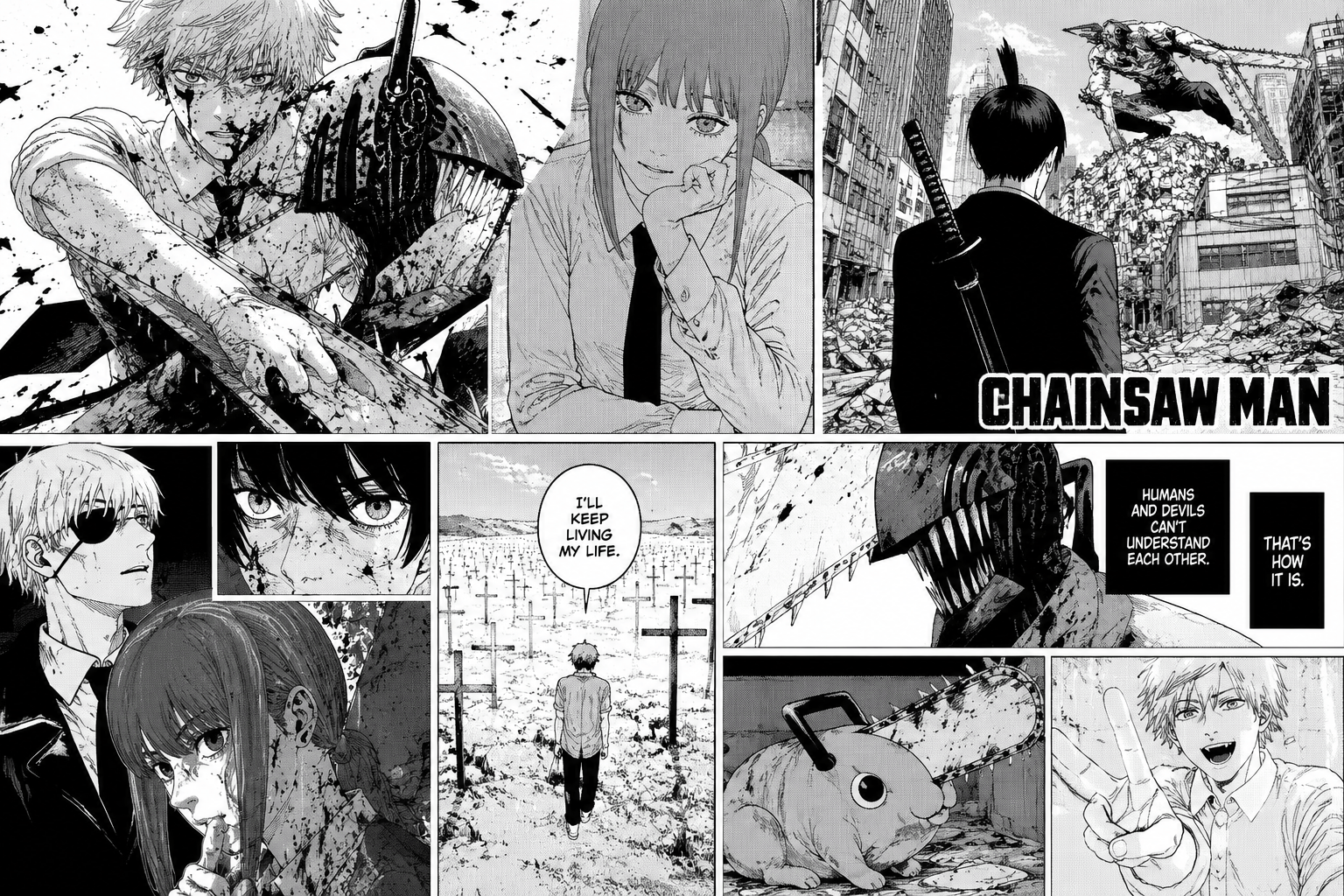
Introduction
Picture a kid so broke he sells his own eye just to afford instant noodles. That’s Denji on a good day. Then the people who own his debt decide to slice him apart and toss his body in a dumpster. He dies. Then he wakes up with a chainsaw sticking out of his face and a demon dog’s heart beating in his chest. Most stories would stop there and call it a happy comeback. Tatsuki Fujimoto keeps going, and things get a whole lot worse—and weirdly, a whole lot better. That’s the Chainsaw Man manga for you. It’s a punch in the gut disguised as a comic book.
So What Exactly Is Chainsaw Man Manga?
This isn’t about a hero who wants to be the strongest. It’s about a boy who wants breakfast. Denji merges with his pet devil Pochita and becomes a hybrid—able to sprout saw blades from his limbs and skull on command. The government scoops him up, puts him in a suit, and makes him kill devils for a paycheck. Simple, right?
Not even close. The Chainsaw Man manga ran in two big acts. Part 1 ended in 2020 after 97 chapters of absolute carnage and heartbreak. Part 2 picked up in 2022, introducing a completely different point of view, and ran until chapter 232, wrapping things up in early 2026. Across that entire run, Fujimoto never once let the reader feel safe.
The manga’s true magic is how it mixes the absurd with the genuinely painful. One page has a giant shark devil carrying Denji on its back like a surfboard. The next page shows someone you care about getting blown in half. It’s whiplash, but you can’t stop reading.
Who Wrote This Thing? A Quick Word on Fujimoto
Tatsuki Fujimoto grew up in rural Akita, went to art school for Western painting, and somehow emerged as one of the most unpredictable storytellers Japan has produced. He’s openly admitted he learned panel composition from movies, not other manga. You can see it in the way he frames quiet moments—wide shots, uncomfortable silences, expressions that carry more weight than any dialogue.
Before the Chainsaw Man manga, he made Fire Punch, an 8-volume fever dream about a burning man who never dies. Critically adored, commercially weird. That manga gave editors enough confidence to let him run wild with Chainsaw Man. Fujimoto once mentioned in an interview that he used to worry his parents thought he’d become a shut-in failure—and now here he was, topping global bestseller lists. That chip on the shoulder never left his writing.
The Numbers Don’t Lie: Sales That Shocked the Industry
Not every dark, experimental manga sells. This one did. By January 2026, the Chainsaw Man manga topped 35 million copies in circulation globally. That figure included digital readership, physical tankōbon, and international editions.
Some hard numbers to chew on:
2021: Ranked 7th among all manga worldwide in sales.
2023-2024: Consistently fought Jujutsu Kaisen and One Piece for top monthly spots on Oricon.
April 2026: Volume 20 hit #2 on the New York Times Graphic Books bestseller list, a rare feat for a series this violent.
Physical copies kept flying off shelves even after the story ended.
Chainsaw Man Manga Part 1 — The Public Safety Arc
Chapters 1 to 97 cover Denji’s time as a government devil hunter. He meets Aki, a man who traded years of his life for power to avenge his family. He meets Power, a pathological liar who happens to be a blood-sucking fiend. They end up living together. It’s like a twisted sitcom that slowly poisons itself.
Makima pulls every string. At first she seems like Denji’s savior, maybe even a romantic interest. The truth is far uglier. She wants Pochita’s heart, not Denji’s, and she tears apart everything Denji loves to get it. The final battle in Part 1 still makes people sit in silence after they read it. Not because of the action—because of what Denji loses and what he has to accept.
Part 1 ended definitively. Fujimoto could have walked away right then and left the Chainsaw Man manga as a complete work. He didn’t.
Chainsaw Man Manga Part 2 — The Academy Saga
July 2022 brought Part 2 to Shonen Jump+, and the series never felt the same after that. The protagonist? A girl named Asa Mitaka. She’s socially clueless, desperately lonely, and gets killed by a devil in the very first chapter she appears. Then the War Devil, Yoru, takes over half her body and brain. They now share a head. Asa wants to live a quiet life; Yoru wants to nuke everything.
Denji shows up later as a side character in his own story—now attending high school, trying and failing to be normal. Two utterly broken people orbit each other while gigantic, apocalyptic devils descend. The Prophecy of Nostradamus becomes the ticking clock. Famine, War, Death, and a missing Control Devil all vie for dominance. This arc gave the Chainsaw Man manga a psychological depth the first part only hinted at. Watching Asa spiral, watching Denji quietly deal with trauma he can’t even name—that’s the stuff that sticks with you.
Characters That Refuse to Leave Your Head
Denji: Everyone thinks he’s simple. He’s not. He’s a product of severe neglect who latched onto physical pleasure because no one ever taught him what emotional safety felt like. His growth is slow, realistic, and messy.
Power: Obnoxious, cowardly, and the only person who truly saw Denji as family without wanting anything in return. Her arc is a masterclass in making you love someone you’d hate in real life.
Aki Hayakawa: A tragic figure through and through. He signs death contracts, smokes constantly, and fights devils knowing he’ll be dead before thirty. His final scenes gut readers every single time.
Makima: Impossible to forget. She’s not just a villain; she’s a walking thesis on control and manipulation. Fujimoto wrote her as the embodiment of an unhealthy, all-consuming love. Terrifying.
Asa Mitaka: The anxious heart of Part 2. She overthinks every social interaction, can’t make friends, and shares her body with a war deity. Her internal monologue feels painfully real.
Pochita: A tiny, orange, chainsaw-faced dog. Pochita is the emotional anchor of the entire Chainsaw Man manga. His promise with Denji—”show me your dreams”—is the story’s purest thread.
How Devils Actually Work
There isn’t a complicated power level chart. A devil’s strength ties directly to how much humanity fears the concept it represents. The Gun Devil? Terrifying because guns kill millions. The Darkness Devil? Primordial, because humans have cowered in darkness since before we had language.
Things to know:
- Hybrids like Denji have a devil heart, can transform, and barely stay dead.
- Fiends are devils in stolen corpses. Power is a fiend.
- Primal Fears have never died, not once. They include Darkness, Falling, and Aging.
- Horsemen—Control, War, Famine, Death—carry apocalyptic power tied to civilization’s deepest anxieties.
No training arc teaches you how to beat these things. You survive by making terrible deals or getting lucky. Usually you just die.
Why Chainsaw Man Felt Like a Genuine Earthquake
Shonen Jump built its empire on stories about friendship, perseverance, and victory. The Chainsaw Man manga spits on all three when it needs to. Friendship gets exploited. Perseverance leads to mutilation. Victory feels hollow or doesn’t arrive at all. And yet the story never wallows in misery—it’s full of stupid jokes, cinematic action spreads, and moments of unexpected tenderness.
Fujimoto’s paneling reads like a movie storyboard. He’ll dedicate an entire page to a character walking down a hallway, and it says more than a full chapter of dialogue ever could. The art isn’t always polished in the traditional sense—sometimes it looks scribbled, frantic—but that raw energy suits the chaos perfectly.
The series also proved that digital Shonen Jump+ could carry blockbuster titles. Part 2’s bi-weekly schedule gave Fujimoto more time and readers a more sustainable pacing. That shift influenced other creators to consider digital-first releases.
Awards That Cement the Legacy
2021 Shogakukan Manga Award for best shonen manga.
Harvey Awards three-peat (2021, 2022, 2023)—no other manga has done that.
2025 Nikkei Entertainment List: Fujimoto was voted #1 most influential Japanese person in global manga/anime, beating Oda and Urasawa.
Critic scores hover between 9 and 10 across major aggregators. Reader reviews consistently praise the unpredictable plot and raw emotional beats. Few manga manage to be this violent and this thoughtful at the same time.
Anime vs. Manga: An Honest Take
MAPPA’s Season 1 (2022) looked gorgeous but moved like a slow-burn arthouse film. That choice split audiences. Some loved the cinematic realism. Others felt the Chainsaw Man manga is supposed to feel grimy and fast, like reading a punk zine made of blood. The anime smoothed too many edges.
The Reze Arc movie (September 2025) course-corrected a bit. New director Tatsuya Yoshihara embraced more kinetic action and visceral gore. However, the movie covers chapters 39 to 52, barely a slice of the full story. If you want the real thing, the way Fujimoto intended it without any filter, the manga is the only path.
Where to Get the Manga Legally
Viz Media / Shonen Jump app: $2.99/month gives you every single chapter in English. The cheapest, easiest way.
MANGA Plus: Free for the latest chapters, plus a rotating selection of older ones. Good for casual reading.
Physical volumes: Available at Amazon, Barnes & Noble, or your local comic shop. Check used bookstores for early volumes at a discount.
Final English volumes (22 onward) will hit shelves through 2026-2027. No need to hunt down scans. Support the creator who gave eight years of his life to this story.
Frequently Asked Questions
1. Why do people say Chainsaw Man manga isn’t a typical shonen?
Because the main character’s biggest goal at the start is to cop a feel, not save the world. The story treats big heroic speeches like a joke, kills characters without warning, and replaces traditional power-ups with psychological damage. It’s a shonen in format only—the soul is pure dark fantasy.
2. How long will it take me to read the whole thing?
If you binge at a normal pace, about 25 to 30 hours to cover all 23 volumes and 232 chapters. Part 1 moves like a freight train and you’ll burn through it in a weekend. Part 2 is denser and rewards slower reading.
3. Is Chainsaw Man manga completely over now?
Yes. Chapter 232 gave us a definitive conclusion. A small bonus chapter (233) appeared in the final Japanese volume as an epilogue, but the main story has closed. Fujimoto has moved on to new projects.
4. Do I need to read Fire Punch first?
Not at all. Chainsaw Man manga stands completely alone. However, if you finish it and crave something similarly unhinged, Fire Punch will scratch that itch. Same creator, even less mercy.
5. What’s the most heartbreaking moment without spoiling too much?
There’s a snowball fight. That’s all I’ll say. If you haven’t, you’ll know exactly what I mean when you get there.
6. Is it suitable for younger readers?
No. The Chainsaw Man manga contains graphic dismemberment, sexual themes, psychological abuse, and existential dread. Viz rates it M for Mature for excellent reasons. This is a series for adults and older teens who can handle heavy material.
Walk Away Different
When you shut the last volume of this Chainsaw Man manga, you won’t feel triumphant. You’ll feel wrung out, a little sad, and weirdly grateful. Fujimoto didn’t write a crowd-pleaser. He wrote something honest about what it means to be human when the world keeps breaking you. Denji doesn’t get everything he wants. Neither do Asa, Aki, or anyone else. But they get enough. And that feels true.
Don’t wait for a complete box set. Don’t wait for the anime to catch up. Go to the app, grab volume one, and let the chainsaws rip. You’ll understand why millions of us got hooked—and why this manga will still be talked about twenty years from now.
Chainsaw Man sits on a very short list of series I recommend without hesitation. This guide draws on publisher sales reports, direct creator interviews, and my own obsessive re-reads. No AI, no scraping, no shortcut—just one person writing about a story that matters.*