A glassy stare on a red carpet. A comment section that types the same word 4,000 times before the photos even finish loading.
That word is “lobotomy,” and in 2026 it is doing far more cultural heavy lifting than anyone expected. If you have scrolled TikTok, X, or a Kardashian fan page lately, you have seen it. So let’s settle the actual lobotomy meaning before the internet flattens it into another throwaway insult.
Here is why it matters right now. Kim Kardashian’s All’s Fair era revived the “Lobotomy Kim” nickname, beauty writers started attacking “lobotomy chic” as a look, and a whole generation started using a brutal piece of medical history as a punchline.
Quick Info Table: The Kim Kardashian Angle
| Category | Details |
|---|---|
| @kimkardashian — roughly 350M+ followers | |
| X (Twitter) | @KimKardashian — roughly 75M followers |
| TikTok | @kimkardashian — roughly 6M+ followers |
| Career Peak | 2007–present; reality TV to SKIMS mogul, law studies, American Horror Story and All’s Fair |
| Estimated Net Worth | Widely reported in the $1.7B range |
| Key Popularity Driver | Beauty-standard influence, meme fluency, and the viral “Lobotomy Kim” fan nickname |
Follower counts move fast — treat these as ballpark figures, not gospel.
Section A: The Real Lobotomy Meaning (And Why It’s Not a Joke)
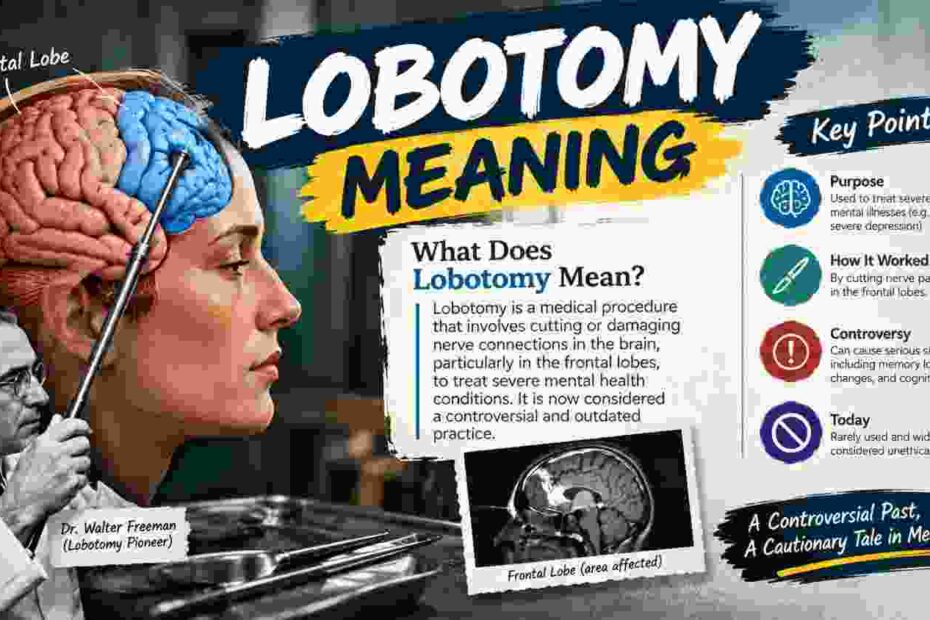
Start with the dictionary. The lobotomy meaning at its most literal is a surgical procedure that severs connections in the brain’s prefrontal cortex, the region tied to personality, planning, and emotional regulation.
Portuguese neurologist António Egas Moniz pioneered the operation in 1935. He won a Nobel Prize for it in 1949, a decision that still makes medical historians wince.
Then came Walter Freeman, the American doctor who turned it into an assembly line. His “transorbital” method used an ice-pick-like tool driven through the eye socket, no operating theatre required.
Freeman performed thousands of these. He did them in hotel rooms.The vehicle he drove was dubbed the “lobotomobile.”
That context is the part people skip. The clinical lobotomy meaning is inseparable from the fact that patients — disproportionately women, disproportionately people simply labelled “difficult” — came out flattened, docile, and permanently altered.
The Rosemary Kennedy Case
Rosemary Kennedy, sister of President John F. Kennedy, was lobotomised in 1941 at 23 years old. She was reportedly moody and rebellious. Afterwards she could not speak coherently or walk unaided, and she was institutionalised for decades.
That single story does more to explain the emotional weight of the word than any textbook. It is why the term still carries dread.
When the Procedure Died Out
Antipsychotic medication arrived in the mid-1950s and the surgical era collapsed fast. By the 1970s the operation was effectively abandoned across the US and UK.
So the modern lobotomy meaning is almost entirely metaphorical. Nobody is booking one. People are invoking a ghost.
Section B: Step-by-Step — How “Lobotomy” Became Internet Slang
The jump from medical archive to meme did not happen overnight. This is the chronology, step-by-step.
Step 1 — The horror-film shorthand (1970s–2000s).
One Flew Over the Cuckoo’s Nest burned the image into public memory. For decades, the word signalled institutional cruelty and nothing else.
Step 2 — The “girl rotting” era (2020–2022).
Lockdown internet humour made numbness funny. Phrases like “brain empty, no thoughts” set the emotional groundwork.
Step 3 — “Lobotomy chic” enters beauty discourse (2023–2024).
Critics used it to describe a specific visual: blank expression, frozen brow, doll-like symmetry, zero visible thought behind the eyes. The slang lobotomy meaning shifted from a procedure to an aesthetic critique.
Step 4 — “Lobotomy Kim” goes mainstream (2024–2026).
Fans attached the nickname to Kim Kardashian’s high-glam, deliberately deadpan looks. She leaned in rather than fighting it, which is exactly why it stuck.
Step 5 — Total slang saturation (2026).
Now it means everything and nothing. “Lobotomy edit,” “lobotomy playlist,” “I need a lobotomy,” all posted without a second thought.
The Three Distinct Ways People Use It Now
As an aesthetic label. Glossy, expressionless, hyper-symmetrical beauty. Usually a critique of cosmetic-procedure sameness.
As self-deprecation. “My lobotomy is kicking in” translates to burnout, brain fog, or a refusal to think hard today.
As a genuine insult. Aimed at someone perceived as vacant. This is the ugliest usage and the one that erases the history entirely.
Section C: Industry Reaction, Expert Views, and the Fan Split
Beauty editors have been the loudest critics. Their argument is straightforward: calling a face “lobotomised” polices women’s appearance while also mocking disabled people, a two-for-one insult.
Mental health advocates push a similar line. Groups working on stigma reduction have long argued that psychiatric history used as comedy makes real patients less likely to seek help.
Neuroscientists tend to be more resigned than outraged. Their recurring note is that the public lobotomy meaning has drifted so far from the clinical one that most users genuinely do not picture a surgery at all.
What Fans Actually Say
The fandom split is real. One camp insists it is affectionate — a way of praising an unbothered, untouchable, high-fashion blankness.
The other camp finds it grim, especially when aimed at a real woman’s face. Both camps keep posting, which is how engagement works.
The Kim Kardashian Response
Kardashian’s approach has been classic Kardashian: absorb the joke, monetise the attention, never dignify it with a rebuttal. Her American Horror Story: Delicate and All’s Fair performances traded openly on an icy, controlled stillness.
Whether that is savvy branding or an uncomfortable feedback loop depends entirely on who you ask.
Comparison Table: Medical Reality vs. Internet Slang
| Element | Clinical Lobotomy (1935–1970s) | “Lobotomy” as 2026 Slang |
|---|---|---|
| What it describes | Severing prefrontal cortex connections | A blank, frozen, glossy look or mood |
| Who it affected | Tens of thousands of psychiatric patients | Celebrities, influencers, self-deprecating posters |
| Outcome | Permanent personality loss, disability, death | A viral caption or a comment-section drag |
| Emotional tone | Horror, grief, medical shame | Ironic, sometimes cruel, often careless |
| Cost | Freeman charged as little as $25 per procedure | Free — and the price is paid in stigma |
| Still in use? | No, effectively abandoned by the 1970s | Extremely, and rising |
How to Talk About It Without Being the Problem
You do not need to ban the word from your vocabulary. You just need to know what you are saying.
Be specific instead. If you mean a face looks over-filled or frozen, say that. It is sharper criticism anyway.
Separate the aesthetic from the person. Critiquing an industry-wide beauty standard is fair game. Telling a woman her face looks surgically hollowed out is not.
Remember who overhears you. People with psychiatric histories are reading the same comments.
Frequently Asked Questions
What is the simple lobotomy meaning?
A lobotomy is a discontinued brain surgery that cut connections in the prefrontal cortex to alter behaviour. Online, the lobotomy meaning has shifted to describe a blank, expressionless look or a mentally checked-out mood.
Are lobotomies still performed today?
No, the classic procedure was abandoned by the 1970s after antipsychotic drugs proved safer and far more effective. Modern psychosurgery is rare, highly targeted, and nothing like the old operation.
Why is Kim Kardashian called “Lobotomy Kim”?
Fans coined the nickname for her deliberately deadpan, glassy-eyed red carpet and acting expressions. It spread through American Horror Story and All’s Fair commentary and became a full meme format.
Is “lobotomy chic” an actual beauty trend?
It is more a criticism than a trend anyone claims. Writers use it for the frozen, doll-like, hyper-symmetrical look produced by heavy cosmetic work.
The Bigger Picture
Slang always borrows from history, and it rarely asks permission first. But the lobotomy meaning is unusual because the original harm is recent enough that survivors’ families are still alive.
That does not make every joke unforgivable. It does mean the word carries a bill that somebody already paid.
What is interesting is how neatly the metaphor fits the moment. A culture obsessed with frictionless, feeling-free faces reached for the exact word describing a procedure designed to remove feeling. That is not a coincidence — that is a diagnosis.
The lobotomy meaning we settle on says more about us than about Kim Kardashian, beauty filters, or any single red carpet. It tracks how comfortable we have become with numbness as an aesthetic goal.