You tap open your brokerage app, type three letters into the search bar, and a fund holding 500 of the biggest companies on earth pops up for the price of a takeaway coffee. That single tap is the whole story of modern investing in one screen.
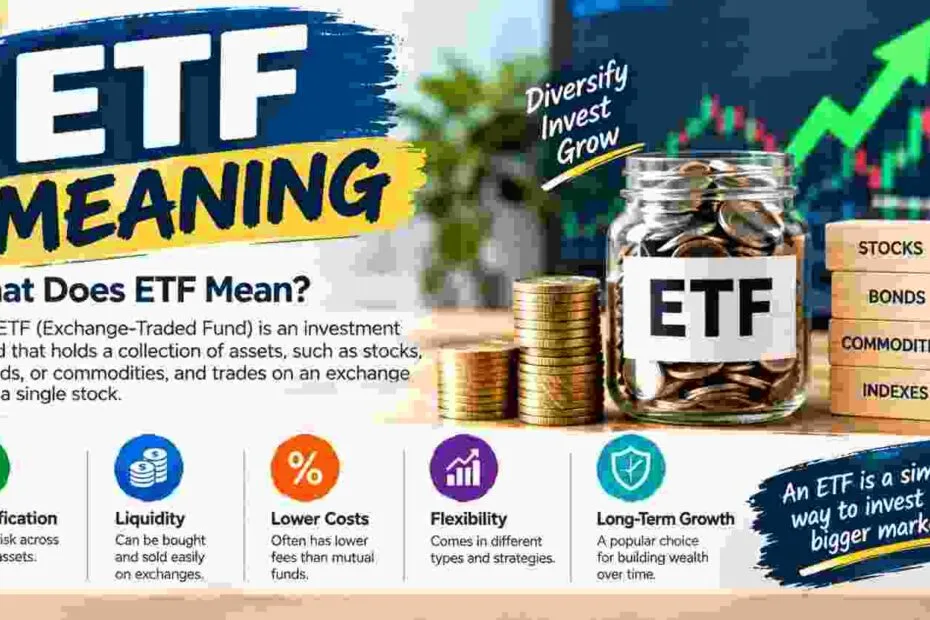
The ETF meaning most people half-remember goes something like “a basket of stocks,” and honestly, that is not wrong. It is just not enough to make a decision with. An exchange-traded fund is a pooled investment you buy and sell on a stock exchange exactly like a single share, all day long, at a live price.
Why is this blowing up right now? Because 2024 and 2025 handed the category two mainstream moments at once: spot crypto ETFs landing on regular brokerage menus, and the ongoing bleed of money out of expensive active mutual funds into cheap index trackers. Add in the wave of retail investors who started during the meme-stock years and have since matured into boring, beautiful index buyers, and the search volume makes sense.
So let us do this properly. Background, mechanics, real numbers, a step-by-step buying guide, the criticism, and the questions everyone actually types into Google.
Quick Facts Table: The ETF at a Glance
| Data Point | The Detail |
|---|---|
| Full Name / “Handle” | Exchange-Traded Fund (ETF) |
| Launch Year / Origin Story | 1990 (Canada, TIPS 35); 1993 US breakout with SPY |
| Global Assets Under Management | Roughly $14–15 trillion worldwide as of 2025 |
| Typical Cost | 0.03%–0.20% annual expense ratio for broad index funds |
| Biggest Single Fund | SPY / VOO / IVV territory — each well past $500bn |
| Career Peak Moment | Jan 2024 spot Bitcoin ETF approval in the US |
| Key Popularity Driver | Low fees, instant diversification, intraday trading |
| Where It Trades | NYSE Arca, Nasdaq, LSE and most global exchanges |
Section A: The Background Story — How We Got Here
Before ETFs, the retail option was the mutual fund. You sent your money in, and you got one price per day, calculated after the market closed. No live trading, often a sales load, and frequently a fee north of 1% for performance that trailed the index anyway.
The 1987 crash pushed regulators and exchanges to think harder about a tradable basket product. Canada got there first in 1990. The United States launched the S&P 500 Depositary Receipt, popularly referred to as the “Spider,” in January 1993.
It was slow at first. Advisers did not know how to charge for it, and investors did not trust something that sounded like a gimmick. Then the 2008 crisis arrived and blew a hole in the credibility of expensive stock-pickers.
Money started moving. By the mid-2010s the flow into index ETFs was less a trend and more a migration. The ETF meaning shifted in the public mind from “niche trading tool” to “the default way normal people own the market.”
The Mechanic That Makes It Work: Creation and Redemption
Here is the part almost nobody explains, and it is the actual engine.
ETFs do not sell shares directly to you. Large institutions called Authorised Participants assemble the underlying basket of securities and swap it with the fund provider for big blocks of ETF shares, usually 50,000 at a time.
Those blocks then get sold into the open market, where you buy them. When the ETF price drifts above the value of its holdings, APs create more shares and sell them, pushing the price back down.
When it drifts below, they buy cheap shares and redeem them for the underlying stock. This arbitrage loop is why an ETF tracks its net asset value so tightly. It is also the reason ETFs are tax-efficient — that in-kind swap avoids the forced selling that triggers capital gains inside mutual funds.
What “Exchange-Traded” Actually Buys You
Intraday pricing sounds like a trader’s toy, and for long-term investors it mostly is. But it has practical value.
You can set a limit order. The actual amount you paid is visible. You can exit at 10:04am if life demands it, instead of waiting for a 4pm close you cannot control.
Section B: Step-by-Step — Buying Your First ETF
This is the practical part. Five steps, no fluff.
Step 1: Pick the Account Wrapper First
Before the fund, choose the tax shelter. In the US that is a Roth IRA or 401(k) before a taxable brokerage account. In the UK it is a Stocks and Shares ISA, then a SIPP.
Getting this order right is worth more over 30 years than agonising over which index fund to pick. Tax drag compounds just like returns do, only against you.
Step 2: Decide What You Want to Own
Broad global equity is the standard starting point. Think total world, total US market, or a developed-markets tracker.
Sector funds, single-country funds and thematic funds are the spice, not the meal. If a fund’s name contains a buzzword, assume the theme already peaked before the fund launched.
Step 3: Read Four Numbers, Ignore The Marketing
Check the expense ratio, the assets under management, the average daily volume, and the tracking difference. Anything under 0.20% for a broad index is fine, and under 0.10% is excellent.
AUM above $500m and healthy daily volume means tight spreads and low closure risk. Tracking difference tells you how closely the fund actually matched its index after costs — more honest than the headline fee.
Step 4: Check the Structure and Domicile
Physical replication means the fund genuinely holds the stocks. Synthetic means it uses a swap contract with a bank, which adds counterparty risk for a slightly tighter track.
Dividends are automatically reinvested when funds are accumulated; they are paid out when funds are distributed.Non-US investors should look hard at Ireland-domiciled funds for the withholding tax treatment.
Step 5: Place a Limit Order, Then Automate
Avoid the first and last fifteen minutes of the trading day when spreads are widest. Use a limit order rather than a market order, especially on anything less liquid.
Then set a monthly automatic contribution and stop watching. The single biggest predictor of ETF investor returns is whether they left it alone.
Product Comparison Table: Four Ways to Own the Same Market
| Feature | Broad Index ETF | Active Mutual Fund | Individual Stocks | Robo-Advisor |
|---|---|---|---|---|
| Typical Annual Cost | 0.03%–0.10% | 0.60%–1.20% | £0 ongoing | 0.25%–0.50% + fund fees |
| Cost on £10,000/yr | £3–£10 | £60–£120 | £0 | £30–£60 |
| Trading | Live, all day | Once daily at close | Live, all day | Provider-scheduled |
| Diversification | Instant, 500–9,000 holdings | Good, but manager-dependent | You build it yourself | Instant |
| Tax Efficiency | High (in-kind redemption) | Lower (forced selling) | You control it | Moderate |
| Effort Required | Very low | Low | Very high | Almost none |
| Best For | Core long-term wealth | Specialist strategies | Conviction bets | Total hands-off |
Section C: Industry Reaction, Expert Views and the Pushback
The professional consensus has shifted hard. John Bogle, who championed the index fund, was famously sceptical of ETFs — not the structure, but the temptation to trade them.
That criticism has aged into the central warning. The product is excellent; the behaviour it enables can be terrible.
Fund analysts at research houses now routinely point out that the average ETF investor underperforms the ETF itself. Buying after rallies and selling after declines are what cause the disparity.
The Concentration Argument
A growing group of academics argues that passive money is distorting price discovery. When trillions flow into market-cap-weighted funds, the biggest companies get bought simply for being big.
Look at the top of the S&P 500 in 2025 and the concern is not abstract. A handful of tech names carry an outsized share of the index, which means your “diversified” fund is more concentrated than it looks.
The counter-argument is fair too: active managers still trade enough volume to set prices, and index investors are price-takers, not price-setters. This debate is not settled, and anyone telling you it is has something to sell.
The Product Proliferation Problem
There are now thousands of ETFs, and a meaningful chunk of them exist because marketing departments needed a launch. Single-stock leveraged funds, 2x daily inverse products, hyper-specific thematic baskets.
These are trading instruments with decay built in, not investments. Holding a leveraged ETF for months is a well-documented way to lose money even when your directional call is correct.
How Retail Investors Are Actually Behaving
The encouraging data point: flows into low-cost core equity funds still dwarf flows into the gimmicks. Reddit’s investing communities, financial TikTok and the FIRE movement have all converged on roughly the same boring advice.
Buy a global tracker, contribute monthly, do not touch it. It is not exciting content, which is exactly why it works.
Frequently Asked Questions
What does ETF stand for in simple terms?
ETF stands for exchange-traded fund, a single investment that holds a basket of many assets and trades on a stock exchange like an ordinary share. Buying one share gives you a slice of everything inside it.
Are ETFs safer than buying individual stocks?
They are generally lower risk because your money is spread across dozens or thousands of holdings, so one company collapsing barely moves the needle. They are not risk-free, though — if the whole market falls, your fund falls with it.
How much money do I need to start investing in an ETF?
The price of one share, which can be anywhere from about $30 to over $600 depending on the fund. Many brokers now offer fractional shares, so you can realistically start with $5 or £5.
Do ETFs pay dividends?
Yes, if the underlying holdings pay them. Distributing funds send the cash to your account, usually quarterly, while accumulating funds reinvest it automatically inside the fund.
Where This Leaves You
Strip away the jargon and the ETF meaning is genuinely simple: it is a cheap, liquid, tax-friendly wrapper that lets one person own a slice of the entire global economy for a few basis points a year. That is a structurally better deal than anything available to retail investors thirty years ago.
The risk was never the product. It is the 4,000 variations layered on top of the good ones, and the very human urge to trade something just because the market is open.
Pick the boring one. Check the fee, check the size, set the standing order, and let three decades of compounding do the heavy lifting while you get on with your life.